


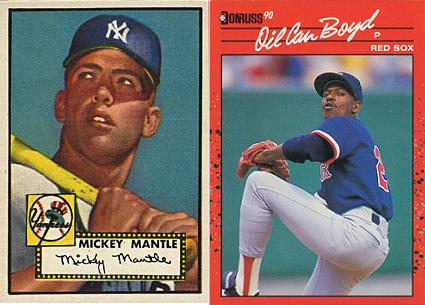
1952 Topps Mickey Mantle Might Hold the Solution to the Era of Overproduction
The 1952 Topps Mickey Mantle is widely considered the greatest card of the modern era. When buying this Mickey Mantle card, the only foreseeable way you'll lose money is if Mantle rises from the grave and shoots Derek Jeter in the head! Morbid, yes, but it illustrates the point. Mickey Mantle's story has already been told and his legacy is carved in stone.
The Wall Street Journal even did a story on how it is one of the safest investments in the world.
What many people don't realize is that the iconic cards from 1952 Topps Baseball is not Mantle's rookie.
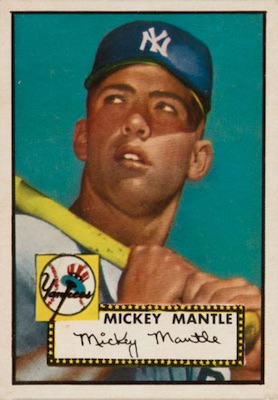
His actual rookie card is from 1951 Bowman Baseball.

So, the question becomes "Why would Mickey Mantle's second-year card be worth so much more than his rookie?"
As the legend goes, during a 1960 "spring cleaning" at Topps' Brooklyn Headquarters, Sy Berger, the father of the modern baseball card and the man who designed the 1952 Topps Baseball set from his kitchen table, rented a large garbage boat and loaded it with 300-500 cases of 1952 Topps Baseball High Series. A tug boat then pulled Berger and the doomed cards from the Jersey Shore into the Atlantic Ocean, where Berger presumably dumped each and every case.
The name "High Series" is another way of saying Series 2. Topps "Low Series" was always a hit, but as the baseball season wore on, interest declined. This was also in part due to the growth of football's popularity in America. Now that football had cut into the "dog days" of summer, Topps was constantly left with an influx of High Series cards. Topps dealt with the overflow by either destroying them or simply printing less. The irony is that the first card in 1952 Topps "High Series" is card #311, Mickey Mantle.
For these reasons, High Series cards tend to be worth more than Low Series cards. The rules of supply and demand are constantly at work in collectibles. This is why short prints (SP) are worth far more than regular base cards. This also explains why many 1980s and 1990s cards are virtually worthless. Although print runs were not fully disclosed, some estimate that from 1987-1997, there were 10 times more cards printed than in any other 10-year span in history.
Here's where the past meets the present. The 1952 Mantle is more than just an extremely valuable card, it's the cardboard blueprint on how to make 1980s and 1990s cards worth something again. It might sound wrong to purposely destroy cards, but I think that it's both necessary and the right thing to do. The card industry almost overprinted itself to death in the '90s. An entire generation grew up to the sobering reality that their cards were worthless, not because of bicycle spokes, but because of reasons they couldn't control, namely overprinting.
No matter how much 1990 Donruss Baseball you dump in the ocean, you can't create a '52 Mantle, but you might end up with a few cards worth putting in a toploader. As things stand right now, there's never going to be much value in baseball card brands like 1988 Fleer, 1990 Donruss and 1991 Topps. But if the collecting community makes a concerted effort to cut the number of '80s and '90s cards in existence, the value has nowhere to go but up.
These are a few sets that could have major potential if the number of cards in circulation was cut down:
- 1989 Upper Deck Baseball
- 1990 Leaf Baseball
- 1989 Score Football
- 1992 Bowman Baseball
I personally will continue my crusade against the "Red Menace" more commonly known as 1990 Donruss Baseball. Here are some other possible ways to make a dent in the card population:
- Create some sort of "card recycling" program with proceeds going to a good cause.
- Get the card companies to buy back and destroy the cards. This would benefit them, too, as a boost in card value helps collectors and card companies.
- Find a rebel billionaire willing to buy $50 million worth of 1980s/1990s crap and dump them in outer space! Sir Richard Branson would be a worldwide hero if he did that!
- Get professional athletes that collect involved. Have signing sessions that "cost" 50 common cards to participate. I know for a fact that former MLB pitcher Pat Neshek is a huge collector.
 | Making purchases through affiliate links can earn the site a commission |







Victor Elias Coria
Excellent article! Although the idea of “recycling” baseball cards sounds good, I believe that it would be great to trade the “dups” to those of us who collect for the mere enjoyment of collecting cards. I penny sleeve my “no-namers” straight out of the package, so I can offer them to those who like gem-mint cards to complete their sets. I have Nolan Ryan, Carl Ripken, Ken Griffey Jr., Jose Canseco, among others which have $$$ value but then I don’t sell them. I like to keep my Picasso on the wall to enjoy and treasure. Protecting baseball cards can be expensive when purchasing penny sleeves, top-loaders, and boxes but I’d rather put my money in penny sleeves and top loaders than drinking and smoking my hard earned money. That’s my choice and it works for me. I earn my money for my hobby by saving plastic bottles, aluminum cans, and glass soda bottles. It earns me about $11.00 a month! So it’s from the recycling center to the card shop! At the present moment I am protecting and cataloging my dup cards so can offer them up to other collectors young and old! So, do recycle those those cards but not as firewood! Happy collecting and don’t forget why you started in the first place…cheers!