Power Up Your Collection: The Ultimate Dragon Ball Super Card Guide
The Complete Guide to Dragon Ball Super Cards

Dragon Ball Super cards are the official trading cards of the Dragon Ball Super Card Game (DBSCG), published by Bandai since 2017 — and they've grown into one of the most popular TCGs in the world.
Here's a quick overview of what you need to know:
| Topic | Quick Answer |
|---|---|
| Publisher | Bandai |
| Game launched | July 2017 |
| Total main sets | 22+ booster sets |
| Card types | Leader, Battle, Extra, Unison, Z-Leader |
| Rarity tiers | Common up to God Rare (GDR) |
| Colors | Red, Blue, Green, Yellow, Black |
| Products | Booster packs, starter decks, booster boxes |
| Where to buy | TCGPlayer, Amazon, local game stores |
Whether you're chasing a God Rare SS Gogeta worth $900+ ungraded, building a competitive deck, or just cracking your first booster box — this guide covers everything.
The game draws on content from across the entire Dragon Ball universe: the original manga, Dragon Ball Z, GT, Super, movies, and even Super Dragon Ball Heroes. That gives collectors and players an enormous pool of iconic characters and moments to collect.
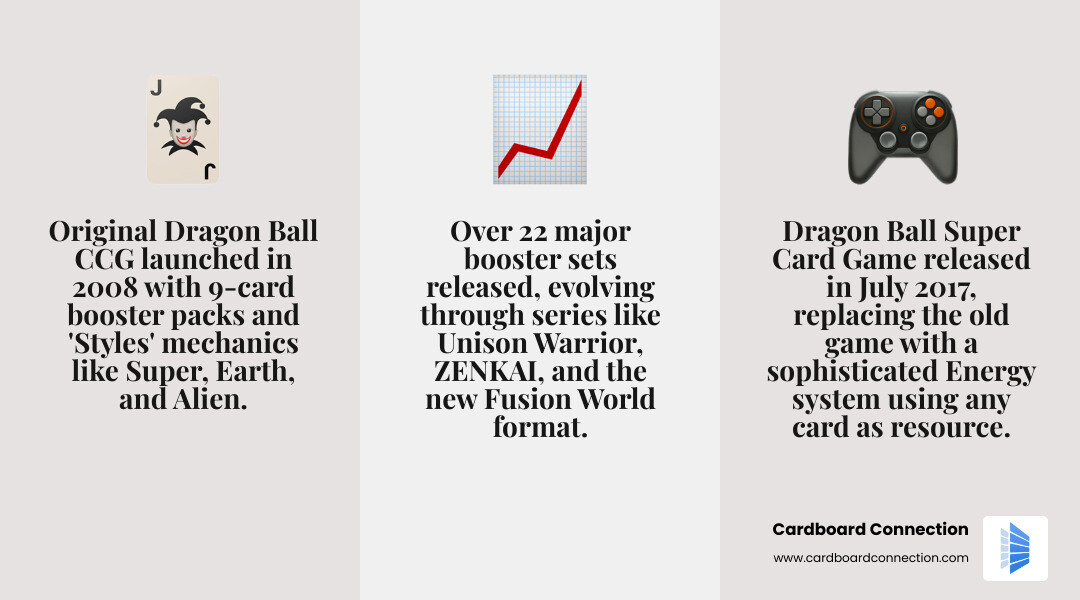
What makes DBSCG stand out from other TCGs? It replaced the original Dragon Ball CCG (2008–2009) with a faster, deeper system — one that has released over 22 major sets, evolved through distinct series like Unison Warrior and ZENKAI, and recently launched a separate format called Fusion World.
Understanding the Dragon Ball Super Card Game (DBSCG)
The modern era of Dragon Ball tabletop gaming began in July 2017 when Bandai launched the current iteration of the game. While there was a previous "Dragon Ball Collectible Card Game" released around 2008, it only lasted about a year. That older game featured 9-card booster packs and mechanics like "Styles" (Super, Earth, Alien, etc.), but it lacks the polish and massive competitive scene of the current series.
The modern Dragon Ball Super cards utilize a much more sophisticated "Energy" system. Instead of just playing cards, you can place any card from your hand into your Energy Area upside down to act as a resource. This means you are rarely "mana screwed," as every card in your deck has potential utility.
According to the Official DBS TCG Website, the game has evolved significantly from its "Galactic Battle" roots. The card anatomy is designed for clarity: you'll find the card name at the top, energy cost in the upper left, and power level on the bottom left. Character traits and eras (like "Frieza Saga" or "Universe Survival Saga") are listed at the bottom, which is crucial for deck-building synergies.
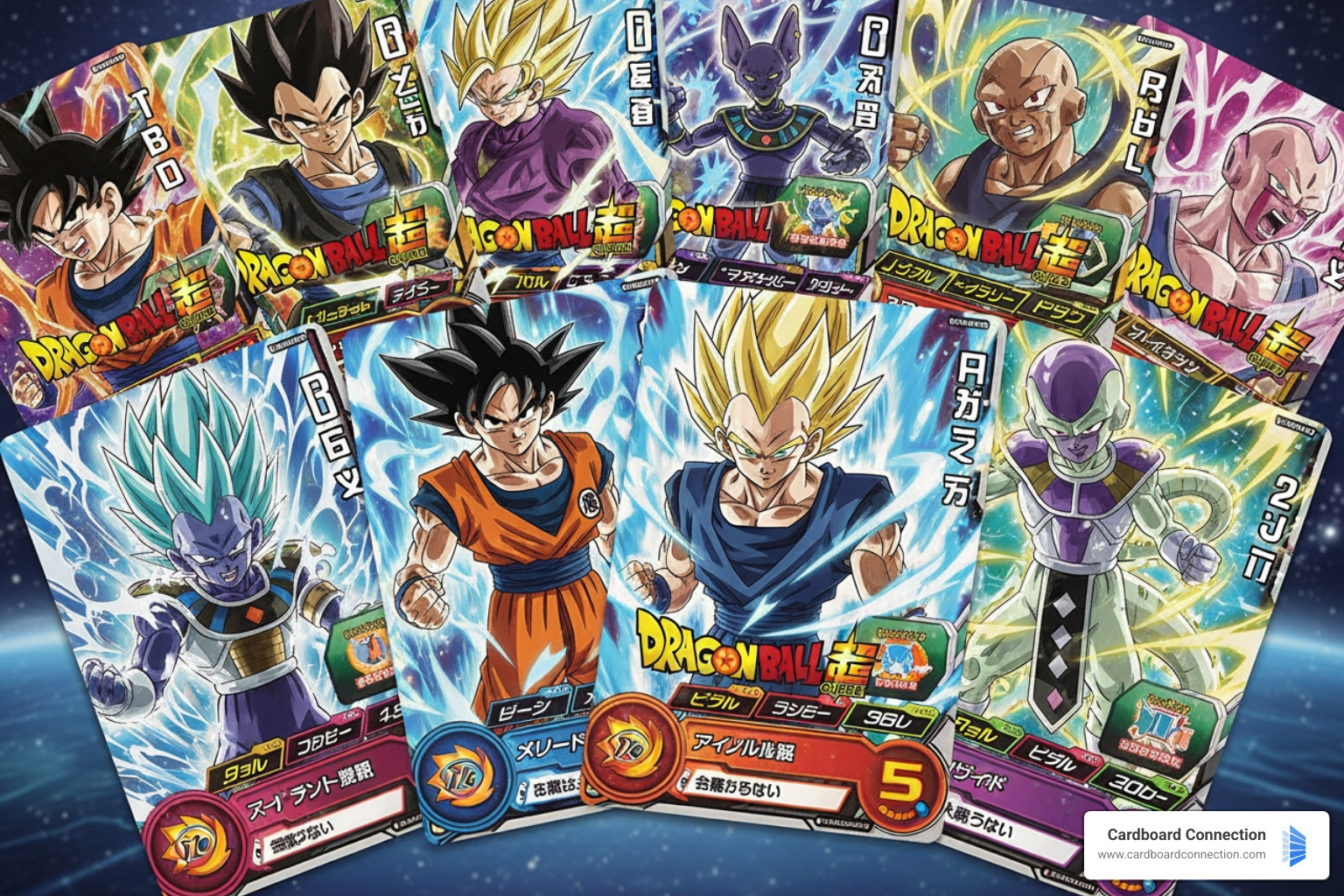
Card Types and Gameplay Roles
To master the game, we need to understand the five primary card types that make up a deck:
- Leader Cards: The heart of your deck. These are double-sided cards that start on their "Front" side and "Awaken" (flip over) when your life drops to a certain level, gaining increased power and new abilities.
- Battle Cards: These are your primary attackers and defenders. They represent characters like Goku, Vegeta, or Broly and have specific power stats (ranging from 1,000 to 100,000).
- Extra Cards: These represent "Spells" or events. They provide powerful one-time effects or defensive boosts during your opponent's turn.
- Unison Cards: Introduced in the Unison Warrior series, these stay on the field and act as "partners" to your Leader, using a marker system to trigger powerful abilities.
- Z-Cards (Z-Leader & Z-Battle): Part of the ZENKAI series, these reside in a special "Z-Deck" and can be played using Z-Energy, which is generated from used cards in your Combo Area.
The Rarity Hierarchy: From Common to God Rare
For many of us at Cardboard Connection, the thrill of Dragon Ball Super cards lies in the "chase." Bandai has created a complex rarity system that makes opening a booster pack feel like a high-stakes event. Most modern sets contain approximately 292 unique cards, categorized by the following tiers:
- Common (C): The backbone of every pack.
- Uncommon (UC): Slightly harder to find, often featuring key utility cards.
- Rare (R): Guaranteed in every pack, usually featuring a foil finish.
- Super Rare (SR): Powerful cards with textured foiling. There are usually about 30 different SRs per set.
- Special Rare (SPR): These are alternate-art versions of SR cards, featuring gold stamping and more intricate prismatic etching.
- Secret Rare (SCR): The ultimate pull in most boxes. Usually, there are only 3 SCRs per set, with a pull rate of roughly 1 or 2 per "case" (12 booster boxes).
Rare Variants in Dragon Ball Super cards
Beyond the standard tiers, Bandai often introduces "luxury" rarities to celebrate specific milestones or themes.
God Rare (GDR) is currently the pinnacle of the hobby. Introduced in the Realm of the Gods set, these cards are exceptionally rare—often estimated at 1 in every 3 to 6 cases. A prime example is the SS Gogeta, Fusion Reborn from the Critical Blow set. Market data shows this card can command prices of $900 ungraded, while a BGS 10 "Black Label" version has been valued as high as $7,750.
Other special rarities include:
- Destruction Rare (DR): Exclusive to certain sets, featuring gods of destruction.
- Infinite Saiyan Rare (ISR): Dedicated to the various forms of the Saiyan race.
- Signature Cards: Featuring the stamped signatures of the original Japanese voice actors (like Masako Nozawa for Goku).
You can find more historical set data regarding how these rarities have shifted since the game's inception in 2017.
Evolution of the Game: Main Sets and Expansions
The journey of Dragon Ball Super cards is divided into "blocks" or series. Each block introduces new mechanics that shift the competitive meta.
- The Early Era (Series 1–9): Focused on basic mechanics like "Union-Fusion" and "Over Realm."
- Unison Warrior Series (7 Sets): Introduced Unison cards, which changed the board state by adding a permanent presence that wasn't a Battle card.
- ZENKAI Series (5+ Sets): Introduced the Z-Deck and Z-Energy, giving players access to a secondary "toolbox" of cards outside their main 50-card deck.
- Fusion World: Launched recently as a more streamlined, "dynamic" version of the game, intended to be easier for new players to learn while still maintaining the tactical depth the series is known for.
The recent Manga Booster 01 set is a great example of the game's evolution, celebrating the 40th anniversary of the franchise with 110 unique card types and 21 Energy Markers inspired by Akira Toriyama’s original manga covers.
Building Decks with Dragon Ball Super cards
Deck building revolves around the five energy colors, each with its own distinct playstyle:
- Red: Aggressive, focuses on reducing the opponent's power and "Critical" strikes.
- Blue: Defensive and tactical, focuses on energy manipulation and returning cards to the hand.
- Green: Destruction-oriented, focuses on forcing the opponent to discard and KO-ing battle cards.
- Yellow: Control-heavy, focuses on "Resting" the opponent's cards and preventing them from untapping.
- Black: Utility-focused, often using the "Warp" (removed from game) area as a resource.
Modern mechanics like Z-Stack (placing cards under a Z-Card to power it up) and Union-Potara (fusing characters into a single powerful unit) add layers of strategy. If you're looking for a specific card to fit your strategy, we recommend using the Official Card Search Database.
Market Trends and Buying Dragon Ball Super cards
The market for Dragon Ball Super cards is vibrant but can be volatile. For those looking to buy, there are several avenues:
- Booster Boxes: Typically containing 24 packs. In India, for example, a Fusion World FB-02 Blazing Aura box might retail for around ₹3,800, while older or more "premium" boxes like Saiyan Showdown can reach over ₹20,000 on platforms like Amazon.
- Singles: For competitive players, buying individual cards (singles) on TCGPlayer or eBay is the most cost-effective way to build a deck.
- Starter Decks: Bandai has released over 20 starter decks, such as The Final Radiance and Proud Warrior. These are excellent for beginners as they provide a legal, 50-card deck and exclusive Leader cards.
Japanese vs. English Versions: It is important to note that Japanese and English cards are generally not interchangeable in official Western tournaments. Japanese cards often feature different release schedules and occasionally exclusive artwork, making them popular with "pure" collectors, whereas English cards are the standard for local organized play.
Frequently Asked Questions about Dragon Ball Super cards
What is the rarest Dragon Ball Super card?
Currently, the God Rare (GDR) cards are the rarest. Specifically, the Realm of the Gods SSB Son Goku (GDR) and the Critical Blow SS Gogeta (GDR) are considered the "holy grails" of the modern game due to their incredibly low pull rates and massive secondary market value.
How do I start playing DBSCG competitively?
The best way to start is by picking up two copies of a recent Starter Deck (to ensure you have a full "playset" of the best cards) and visiting the official website to find a local "Tournament Store." Bandai also hosts massive "Regional" and "National" events for those looking to test their skills at the highest level.
What is the difference between Masters and Fusion World?
"Masters" refers to the original, complex version of the game that has been running since 2017. "Fusion World" is a newer, separate game system with simplified rules and its own digital client, designed to coexist alongside the Masters format.
Conclusion
Whether you are a hardcore competitive player or a collector looking to own a piece of Akira Toriyama's legacy, Dragon Ball Super cards offer something for everyone. From the tactical depth of the ZENKAI series to the breathtaking artwork of the God Rares, the game continues to grow in exciting directions.
At Cardboard Connection, we are dedicated to keeping you updated on every new release. Be sure to check back for our latest checklists and rarity breakdowns. For more on the history of non-sports cards, you can explore our guide on 2019 Entertainment Trading Cards.
Happy hunting, and may your next booster pack contain that elusive Secret Rare
Here are the top deals on Hobby boxes currently listed on eBay:
 |
Making purchases through affiliate links can earn the site a commission |