
TL;DR:
- Rookie cards are scarce and heavily influenced by player performance, draft position, and team prominence.
- Monitoring player news, market trends, and sales data regularly improves investment decisions.
- Tracking demand velocity and avoiding hype-based purchases are key to building long-term rookie card value.
A player’s rookie card can spike 300% in value before they ever play a meaningful playoff game, then crater just as fast when the hype fades. That reality catches many collectors off guard, especially those who assume that holding any rookie card is a safe, long-term play. The truth is more nuanced: rookie card values are living, breathing market signals driven by performance trajectory, team context, draft positioning, and collector sentiment. Understanding why and how to track these cards is what separates collectors who build real value from those who watch profits evaporate. This article breaks down the mechanics of rookie card tracking and gives you the tools to act smarter.
Table of Contents
- What makes rookie season cards unique
- Why tracking matters: How values rise, fall, and grow
- How to track rookie season cards effectively
- Common rookie card tracking pitfalls and expert strategies
- A collector’s perspective: Why tracking rookie cards separates true enthusiasts from casual fans
- Ready to take your rookie card tracking to the next level?
- Frequently asked questions
Key Takeaways
| Point | Details |
|---|---|
| Rookie cards offer scarcity | Because there is only one official rookie season, these cards are naturally rare and highly valued by collectors. |
| Tracking maximizes gains | Active monitoring helps you buy and sell at the right times to capture price surges and avoid common losses. |
| Avoid common mistakes | Steering clear of hype-driven buying and tracking both performance and news will protect your investments. |
| Use tracking tools | Apps, price indexes, and auction sites make it easier to follow rookie card trends and market changes. |
What makes rookie season cards unique
A rookie card (RC) is the first officially licensed card of an athlete produced during their debut professional season. It is not a reprint, a prospect card, or a pre-rookie insert. It is the real thing, and that distinction matters enormously to the market.
The core reason rookie cards command premium prices is simple: one rookie year exists per athlete, making these cards inherently scarce and providing long-term investment potential if the player succeeds. Once that window closes, no manufacturer can produce another legitimate rookie card for that player. That scarcity is baked in from day one.
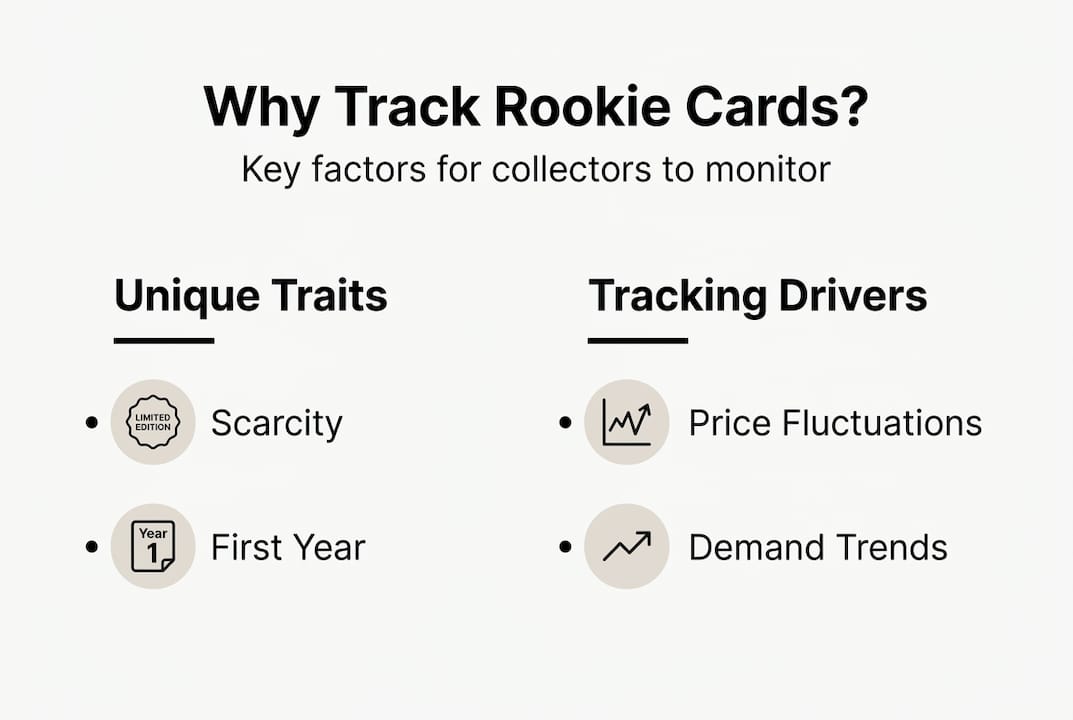
To illustrate how this scarcity translates into value, consider how different card types perform over time:
| Card type | Year 1 avg. value | Year 3 avg. value | Year 5 avg. value |
|---|---|---|---|
| Rookie card (RC) | $25 | $60 | $120 |
| Base card (non-RC) | $5 | $6 | $7 |
| Insert/parallel | $15 | $18 | $22 |
| Autograph RC | $150 | $400 | $900 |
The gap between rookie cards and standard base cards widens dramatically over time, particularly for autographed rookie parallels with serial-numbered print runs. A rookie card’s performance impact on long-term value is well documented across basketball, football, and baseball markets.
Several factors beyond scarcity drive rookie card demand, and collectors should weigh all of them:
- League prominence: NFL and NBA rookie cards consistently outperform MLB and NHL equivalents in raw dollar volume.
- Draft position: Top-5 picks generate immediate collector interest, regardless of actual playing time.
- Team market size: A rookie landing in New York, Los Angeles, or Chicago benefits from larger local collector bases.
- Print run size: Short-printed (SP) and super-short-printed (SSP) rookie card variations carry exponentially higher ceilings.
- Autograph inclusion: On-card signatures from Panini, Topps, or Upper Deck sets command the strongest premiums.
- Position scarcity: Quarterbacks, point guards, and power forwards historically outperform skill positions with shorter career windows.
Collectors who treat rookie cards as foundational investments are responding to all of these signals simultaneously, not just the player’s name on the front.
Why tracking matters: How values rise, fall, and grow
Knowing what makes rookie cards unique, the next step is understanding why tracking their movement is essential. Rookie card markets do not move in straight lines. They spike, correct, plateau, and surge again based on a rotating cast of variables.
Hype cycles are the most volatile force in rookie card pricing. A single standout performance in a nationally televised game can push a card’s value up 40% overnight. Conversely, a quiet stretch of games or a minor injury report can send prices retreating just as quickly. Rookie cards require monitoring of performance trajectory, team context, and draft hype to make sense of these swings.
Here is how player performance and card price often correlate across a rookie season:
| Performance milestone | Typical price reaction | Duration of effect |
|---|---|---|
| Strong preseason showing | +20 to 40% spike | 1 to 2 weeks |
| Starter named in Week 1 | +30 to 60% surge | 2 to 4 weeks |
| Injury or benching | -25 to 50% drop | Sustained |
| Award nomination | +50 to 80% spike | 3 to 6 weeks |
| Championship appearance | +100%+ surge | Long-term hold |
For collectors who want to stay ahead of these moves, a structured tracking approach is non-negotiable. Here are the key steps:
- Identify target players early by monitoring draft boards, combine results, and preseason depth charts before cards even hit the market.
- Set price benchmarks using recent sold listings on major auction platforms to establish a realistic baseline value.
- Monitor roster news weekly, paying particular attention to starting lineup changes, injuries, and trade rumors.
- Cross-reference card sales volume, not just price. A card selling 50 units per week versus 5 units tells a very different story.
- Track limited print rookie cards separately from base RCs, since their price behavior is more extreme and less predictable.
- Review draft impact on rookie prices after each major selection event to recalibrate expectations.
“The collector who buys on hype and sells on data almost always outperforms the collector who does the reverse.”
Pro Tip: Hype spikes after major events like award announcements or playoff runs are often the best selling windows, not buying ones. Prices frequently correct within two to three weeks as the market absorbs the excitement.
How to track rookie season cards effectively
Now that the importance of tracking is clear, here is how collectors can actually stay on top of rookie card trends using a combination of manual research and digital tools.

The foundation of any tracking system is consistent data collection. Sporadic checks produce noise, not signal. Collectors who monitor rookie cards on a regular schedule build a clearer picture of where values are heading.
Key metrics worth tracking on a weekly basis:
- Sold listing prices on eBay and PWCC for the specific card grade and parallel tier.
- Sales volume trends: Is the card moving faster or slower than the previous week?
- PSA/BGS population reports: New graded copies entering the market can suppress prices.
- Player stat lines and game logs: Points, yards, and efficiency ratings directly correlate with short-term demand.
- Social media sentiment: Spikes in hobby community chatter on platforms like X (formerly Twitter) and Instagram often precede price moves by 24 to 48 hours.
Recommended tools and resources for tracking:
- eBay sold listings filter: The most reliable real-time price data available to any collector.
- 130point.com and Market Movers: Dedicated sports card price tracking platforms with historical charts.
- PSA Set Registry and population reports: Essential for understanding supply-side pressure on graded cards.
- Cardboard Connection’s autograph rookie guides and rookie checklist tips: Invaluable for identifying which cards within a set carry the most collector interest.
- Team-based rookie guides: Useful for collectors who focus on specific franchises rather than individual players.
- Google Alerts: Set alerts for a player’s name combined with terms like “injury,” “trade,” or “award” to catch breaking news instantly.
Pro Tip: Do not just track prices. Track demand velocity. A card whose price holds steady but sells three times as fast as last month is building momentum that will eventually push the price higher. Volume is often the leading indicator that price data lags behind.
Common rookie card tracking pitfalls and expert strategies
After mastering the basics, it is equally important to avoid rookie card tracking mistakes and leverage collector wisdom. Even experienced hobbyists fall into patterns that cost them real money.
Common tracking mistakes to avoid:
- Chasing hype without data: Buying after a major spike because of social media buzz, without checking whether the price has already peaked.
- Ignoring injury and suspension news: A single missed game can be noise; a multi-week absence is a signal to reassess.
- Treating all parallels equally: A base RC and a serial-numbered Refractor parallel do not follow the same price curves. Tracking them together produces misleading averages.
- Missing market corrections: Rookie card markets correct seasonally, particularly in the offseason. Collectors who fail to anticipate these dips miss prime buying windows.
- Over-relying on a single platform: eBay sold data is valuable, but it reflects retail buyer behavior. Auction house results and private sales often tell a different story.
Successful tracking requires understanding both scarcity and context, not just hype, and that means looking at the full picture around a player’s situation.
Context factors that influence rookie card demand include team depth chart position, coaching staff philosophy, offensive or defensive scheme fit, and media market size. A highly drafted receiver buried on a depth chart behind two established veterans is a very different proposition than one who steps in as an immediate starter.
Expert strategy: Cross-verify pricing trends across at least three independent sources before making a buy or sell decision. If eBay, a price index platform, and recent auction results all point in the same direction, the signal is strong. If they diverge, wait for clarity.
Base card collecting also plays a role in building tracking intuition. Understanding how base cards behave over time gives collectors a reliable benchmark for evaluating whether a rookie card premium is justified or inflated.
Pro Tip: Keep a simple tracking log, even a basic spreadsheet, recording the date, price, and context for every card you monitor. Comparing a current rookie’s trajectory against a similar player from two or three years ago often reveals whether the current price is ahead of or behind historical norms.
A collector’s perspective: Why tracking rookie cards separates true enthusiasts from casual fans
Most new collectors buy rookie cards and then wait. They hold the card, check the price occasionally, and hope the player becomes a star. That passive approach misses the point entirely.
The collectors who consistently build value treat tracking as a skill, not a chore. They understand that collecting for enjoyment and collecting for profit are not mutually exclusive. Watching a player develop, understanding their role on the team, and connecting that knowledge to card market behavior is genuinely engaging. It deepens the relationship with the sport itself.
Cards sold too early and held too long both carry lessons. A serial-numbered rookie auto sold during a preseason hype spike that later tripled in value after a Rookie of the Year award is a painful but instructive data point. So is a base RC held through a career-ending injury. Both outcomes teach the same lesson: tracking is not optional if you care about results.
The hobby rewards those who pay attention. Tracking rookie cards is not just a financial discipline. It is the clearest expression of genuine engagement with the sport, the players, and the community that surrounds the hobby.
Ready to take your rookie card tracking to the next level?
Cardboard Connection provides collectors with the depth of resources needed to track, evaluate, and invest in rookie cards with real confidence.
From detailed set reviews and checklists to hot lists and player-specific guides, Cardboard Connection covers every angle of the hobby. Collectors looking to understand how cards age in the market can explore articles on trading card public domain rules and timelines. Those building a foundational collection will find the base card collecting guide an essential starting point. Whether you are tracking a single prospect or managing a diversified portfolio of rookie cards, the tools and insights available here are built for collectors who take the hobby seriously.
Frequently asked questions
What is the difference between a rookie card and a regular card?
A rookie card is the first official card of an athlete released during their debut professional season, while regular cards feature players in later years or as non-RC variations. The one rookie year per player rule is what makes RCs inherently scarce and valuable.
How often should I check the value of rookie season cards?
For active markets, weekly checks provide a reliable baseline, but major player events such as injuries, trades, or award nominations may require daily monitoring. Performance trajectory and hype can shift prices significantly within 24 hours of breaking news.
What tools help track rookie season card prices?
Online auction sold listings, dedicated price index platforms like 130point.com, and PSA population reports are the most reliable resources. Monitoring performance trajectory alongside these tools gives collectors a complete picture of both supply and demand.
Does a player’s team change affect the value of their rookie card?
Yes, team changes can shift collector demand considerably, especially when the new context increases media exposure or starting opportunity. Team context and draft hype remain two of the most influential variables in rookie card pricing throughout a player’s early career.